
Artwork Filter:
Showing all 6 resultsSorted by price: low to high
-
Sale!
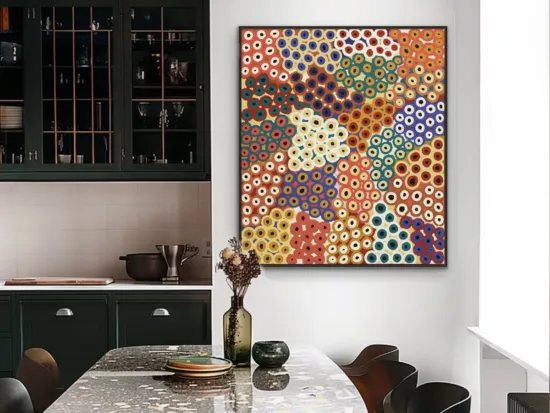
Soakage Sites – 109x95cm
Original price was: $ 3,400.$ 2,800Current price is: $ 2,800. -
Sale!

Wild Flowers, My Grandmother’s Country – 91x122cm
Original price was: $ 4,850.$ 3,950Current price is: $ 3,950. -

Land, My Grandmother’s Country – 180x122cm
$ 7,750 -
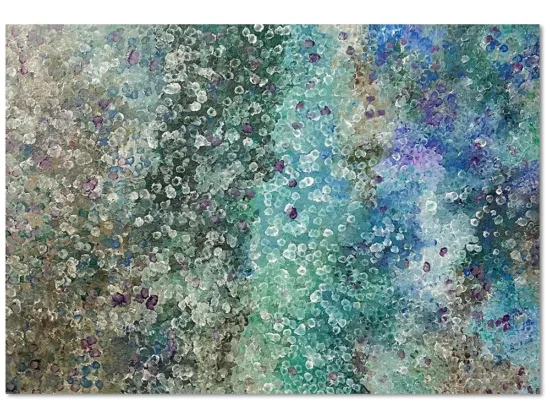
Sea, My Grandmother’s Country – SOLD
$ 7,750 -
Sale!
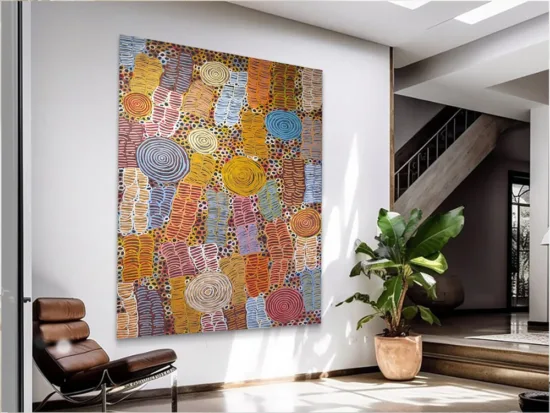
Awelye & Bush Melons – 235x147cm
Original price was: $ 11,450.$ 10,800Current price is: $ 10,800. -

Scorpion Country -206x132cm
$ 11,900
Artwork Filter:
Aboriginal art is the oldest continuous artistic tradition on earth, and the most significant art movement Australia has produced. What reaches the wall of a Sydney home is only the most recent surface of it — but the works in this collection carry a direct, documented line back to one of the movement's most important centres.
Utopia — where this collection comes from
Every work here originates from Utopia (Atnwengerrp), a remote Anmatyerre and Alyawarre community roughly 200–240 kilometres north-east of Alice Springs in Central Australia. When paints and canvas were introduced there, the stories and designs held by the community — until then expressed in ceremony, on the body and in the sand — could be committed to a permanent surface for the first time. What followed made Utopia one of the two or three most consequential places in twentieth-century Australian art.
Its best-known figures are Emily Kame Kngwarreye (c.1910–1996), who began painting on canvas late in life and produced in barely eight years a body of work now regarded as among the finest by any Australian artist, and Minnie Pwerle (c.1910–2006), whose Awelye women's ceremony designs are instantly recognisable.
SOHO's Aboriginal collection sits inside that family. Betty Mbitjana is Minnie Pwerle's daughter. Freddy Purla is Minnie Pwerle's grandson and — in Aboriginal law — Emily Kame Kngwarreye's adopted nephew. This is not a curated resemblance to the Utopia movement; it is the movement's own next generation.
The artists
Betty Mbitjana — Anmatyerre/Alyawarre, Utopia NT. Born out bush in the country surrounding Utopia, daughter of Minnie Pwerle and sister of the artist Barbara Weir. She grew up watching the art movement develop around her, and paints Awelye — women's ceremonial body-paint designs — alongside the bush melon, a food plant of her Country. Her Awelye & Bush Melons is the largest work in this collection at 235x147cm.
Freddy Purla — Anmatyerre/Alyawarre, Utopia NT. Son of Barbara Weir, grandson of Minnie Pwerle. He works in two distinct styles. Sand Dunes replicates the effect of wind moving across the sands of Atnwengerrp; the series was nominated for the Telstra Awards in 2003. Scorpion Dreaming was passed to him through his grandmother's family. As he describes it, the scorpion's sting is painful, so it is left undisturbed and respected at all times; rarely seen in daylight, its criss-crossed tracks in the desert sand are what announce its presence. The paintings take the male and female scorpions' courtship dance — pincers interlocked, moving back and forth for hours — as their subject. His work is held in collections in Australia, Germany, the Netherlands, France, Switzerland and the United States.
Barbara Mpetanye — Alyawarre, Utopia NT. Born 1971. She paints the water soakage sites of her Country. The roundels are water holes seen from above, where the water bubbles up from the ground; Indigenous people of the region know precisely which soakages are fleeting and which are permanent, and that knowledge is the subject. Her palette is deliberately bright and contemporary.
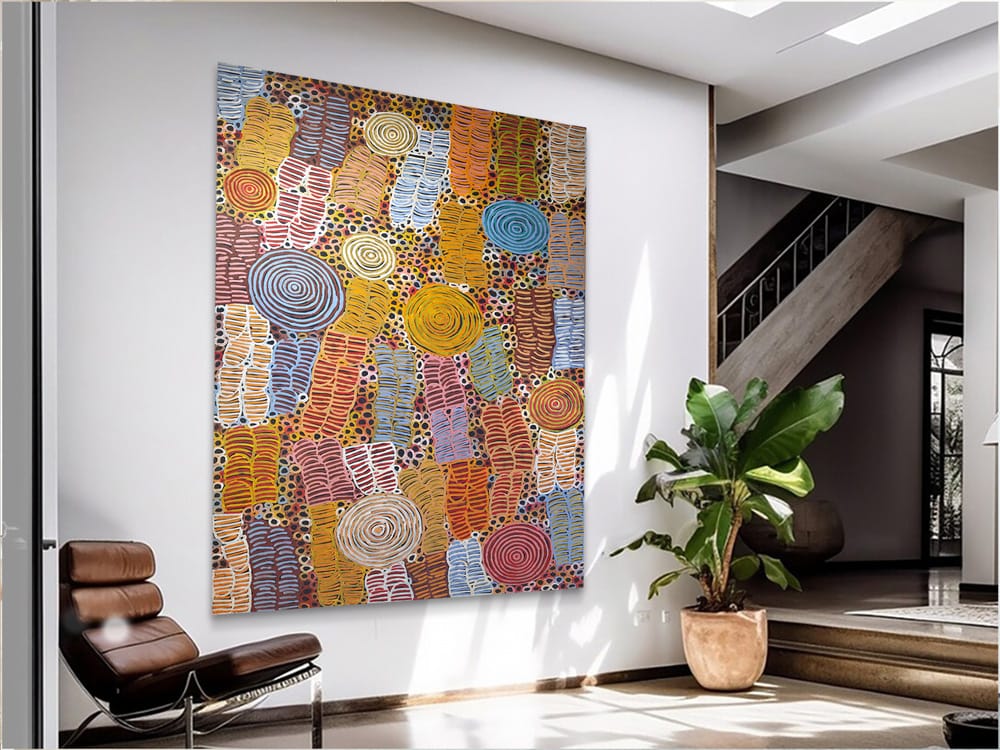
Awelye & Bush Melons - 235x147cm — Betty Mbitjana →
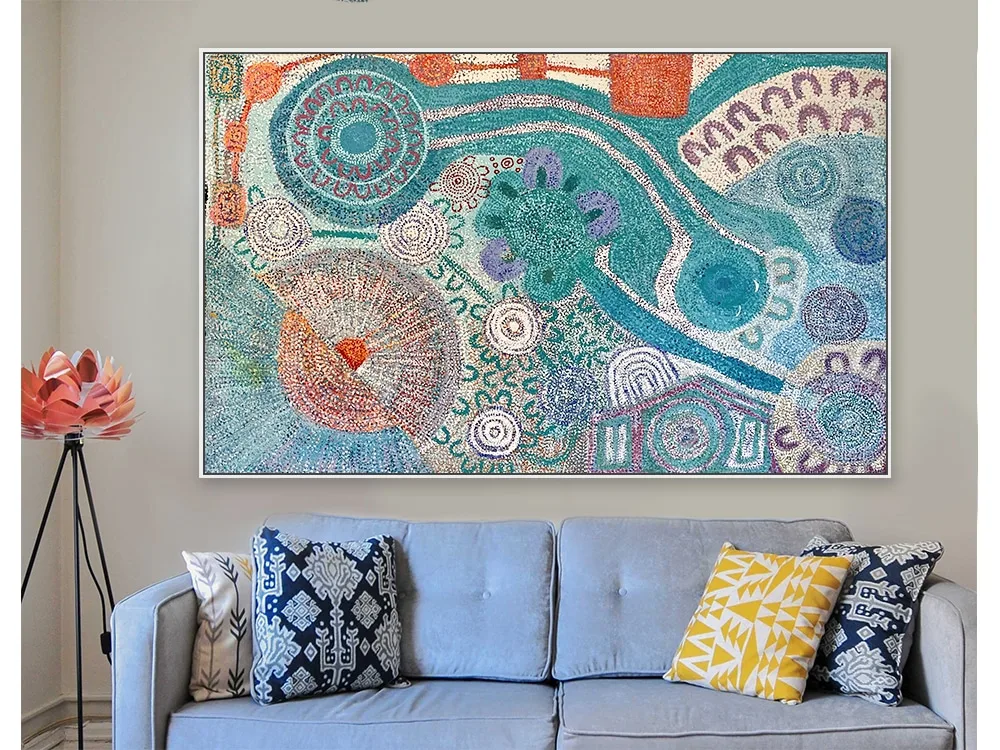
Scorpion Country - 206x132cm — more by Freddy Purla →
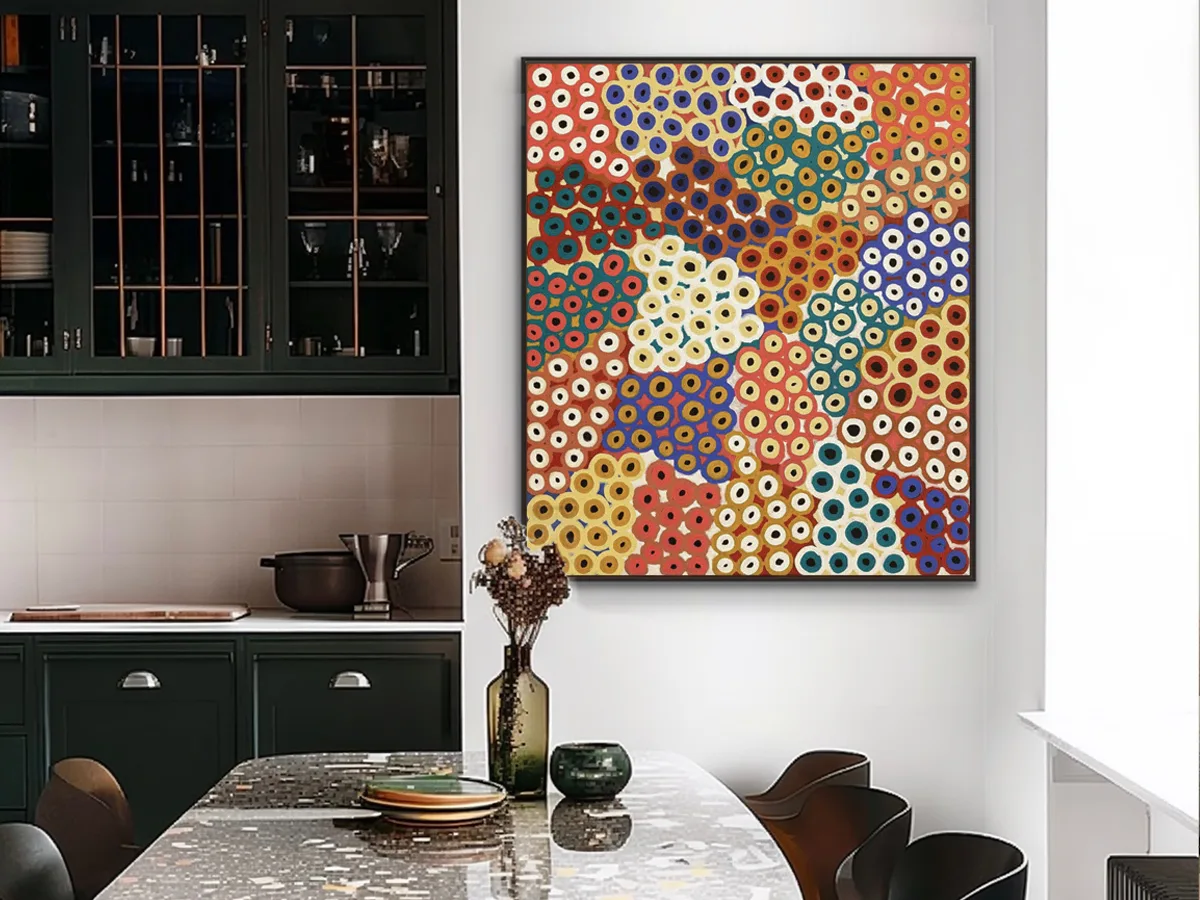
Soakage Sites - 109x95cm — more by Barbara Mpetanye →
Buying Aboriginal art with confidence
The single most important question when buying Aboriginal art is whether the artist was paid properly and the work is what it claims to be. Every piece in this collection is an original acrylic on canvas, supplied with an authenticity certificate naming the artist, and stretched ready to hang.
We name each artist's language group and Country because that information is part of the work, not decoration around it. Where a painting depicts a Dreaming, that Dreaming belongs to the artist through their family — Freddy Purla's Scorpion Dreaming came to him through his grandmother's line — and it is theirs to paint. We describe what the works depict only as the artists themselves describe them.
Prices in this collection range from $2,200 to $10,800, in sizes from 95cm to 235cm.
SOHO Galleries has been Sydney's home for original Australian art for over 35 years, with delivery and installation available nationwide.
If you're interested in any of these works, contact us today.
Aboriginal art FAQ
Where does this Aboriginal art come from? All of it originates from Utopia (Atnwengerrp), an Anmatyerre and Alyawarre community around 200–240km north-east of Alice Springs, and from one extended family within it.
What does Awelye mean? Awelye refers to women's ceremony and the body-paint designs associated with it. It is a central subject for women painters of the Utopia region, including Minnie Pwerle and her daughter Betty Mbitjana.
What are the roundels and dots actually depicting? It varies by artist and by work. In Barbara Mpetanye's paintings the roundels are water soakage sites seen from above. In Freddy Purla's Scorpion Dreaming the marks follow the tracks left by scorpions in desert sand. Each work's description states its subject.
Do the works come with provenance? Yes — each is an original painting supplied with an authenticity certificate naming the artist.
Is it appropriate to buy and display Aboriginal art? Buying an original work directly supports the artist and their community, and displaying it respectfully is welcomed by the artists who sell it. What matters is that the work is genuine, the artist was paid fairly, and the artist and their Country are correctly named — which is why we list those details for every piece.
Can I view these works in person? Yes — our Woollahra gallery in Sydney carries a rotating selection. Contact us to arrange a viewing.